
Your live oak is the biggest feature in your yard, but it can disappear at night. Good oak tree lighting solves this by illuminating the trunk first and then filling the canopy.
Light Up Naples Holiday & Outdoor Lighting designs low voltage systems for live oaks and banyans across Naples, FL, from Port Royal to Pelican Bay. You will learn the techniques, the fixtures, and the mistakes to skip.
Key Takeaways
- Oak tree lighting in Naples starts at the trunk. Light it first, then fill the canopy.
- Uplighting brings drama. Moonlighting casts soft shadows on the ground.
- Banyans need extra fixtures for their roots.
- Tree-safe mounts protect the oak. Solid brass fixtures resist salt air.
Why Do Live Oaks Need Special Oak Tree Lighting in Naples?
Live oaks spread wider than they stand tall, so one small fixture cannot cover them, and low limbs reaching across lawns, pools, and drives need their own beam.
Spanish moss and resurrection fern add texture that a flat wash erases.
Naples oaks hold green leaves nearly all year. The canopy looks full in every season. A weak fixture lights the bark and leaves the foliage dark.
In Old Naples, Aqualane Shores, and Park Shore, mature giants shade entire front yards. Those trees want more fixtures than their trunks suggest. Our landscape lighting crew plans around three goals: show the trunk, fill the canopy, and keep glare off your windows.
How Do You Uplight a Live Oak?
A professional uplighting design aims ground-level spotlights up the trunk and into the canopy, with each fixture placed 8 to 10 feet from the trunk, since closer lights only illuminate the bark.
Match the beam to the tree. Tall trees require a narrow 15 to 35 degree beam. Wide, low canopies require a beam of 35 to 60 degrees. Oaks that reach 50 to 80 feet need fixtures in the 350 to 1,000 lumen range.
Keep the trunk inside the beam. A bright canopy over a dark trunk looks like it floats. Two fixtures on opposite sides illuminate the oak from different angles, creating an attractive view from the street and the lanai in Vanderbilt Beach and Royal Harbor.
Cross-lighting adds depth. Aim one beam from the left and another from the right so the branches create overlapping shadows. That play of light shows off the bark.
What Is Moonlighting, and Does It Work on Oaks?
Moonlighting hangs fixtures high in the tree and points them down, so light filters through the leaves and paints soft, moving shadows below.
This effect works especially well over a patio, lanai, or outdoor kitchen in Naples.
Mount downlights at a height of 20 feet or less for the cleanest light distribution. Use a tree-mount junction box with standoff screws, so the trunk has room to grow.
Pair this effect with uplights on the same oak. The uplight gives drama, and the glow from above adds comfort. You will want both if you host dinners under the canopy.
Which Canopy Lighting Technique Gives the Best Result?
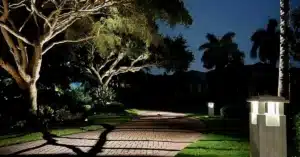
Layering wins, and the best canopy lighting technique stacks three effects: uplight the trunk, wash the leaves, and moonlight the ground.
A designer builds the layers in six steps:
- Walk the yard at dusk and mark every spot the tree is viewed from.
- Measure the canopy height and spread.
- Set the uplights 8 to 10 feet out.
- Add one or two fixtures in the upper limbs.
- Aim after dark and nudge each beam.
- Add a dimmer and a timer.
The lights should be re-aimed every year. Your oak keeps growing, and the beams have to keep up. Properties in Port Royal and Pelican Bay often take this layering further, pairing it with full architectural lighting. See our top luxury Christmas lights for outdoor spaces for that same layered look carried into the holiday season.
How Does Banyan Tree Uplighting in Florida Work?
Banyan tree uplighting starts with the roots, not just the leaves. A banyan produces aerial roots that grow into additional trunks, and these columns respond well to accent lighting.
Graze the columns with narrow spotlights. Then wash the wide canopy with a flood fixture. Hide each fixture in the plants at the base. Banyans thrive in USDA zone 10 and above, which covers Naples.
Check local regulations and consult an ISA Certified Arborist before pruning a banyan. Our palm tree lighting designs use the same hidden-fixture approach for other tropical specimens.
Does Spanish Moss Change How You Light an Oak?
Yes, Spanish moss and resurrection fern change the lighting plan, since both soften a beam’s edge and need a slightly wider spread than bare bark would.
A narrow spotlight aimed directly at a moss-draped limb can overexpose the moss and obscure its underlying texture. Widening the beam a few extra degrees and pulling the fixture back a foot or two usually keeps the moss glowing instead of washing it out, while still lighting the limb it hangs from.
What Does an Oak Lighting Plan Include?
A solid plan has four parts: a fixture map, a beam plan, a cable path, and a control plan. Light Up Naples Holiday & Outdoor Lighting develops all four for every home.
That includes homes in Grey Oaks, Pine Ridge, and Naples Park.
The fixture map marks where each light sits. The beam plan sets the angle for the trunk, the limbs, and the roots. The cable path keeps runs clear of major roots.
The control plan sets the dimmer and timer. Your oak glows at dusk and rests late at night, which saves power and keeps the yard calm.
Which Fixtures Work for Large Canopy Trees?
Wide-beam floodlights and narrow spotlights do most of the work. Solid brass or copper fixtures are also more resistant to corrosion than less durable metals in coastal environments.
Choose 2700K fixtures for a warm, natural glow.
| Fixture | Beam Angle | Best Use |
| Narrow spotlight | 15 to 35 degrees | Tall trunks and high limbs |
| Wide flood | 35 to 60 degrees | Broad live oak canopies |
| In-ground well light | Wide | Hidden uplights near patios |
| Tree-mounted downlight | Wide | Moonlighting over a lanai |
How Do You Protect the Tree and the System in Southwest Florida?
Use tree-safe mounts for the oak and corrosion-resistant components for the system. Avoid tight clamps and never wrap cable around the trunk.
Installers leave extra cable at the base, since the tree will grow.
Can You Add Holiday Lights to a Lit Oak?
Yes, and year-round fixtures make the job easier, since your uplights stay on as the base layer while holiday strands add sparkle on top.
Light Up Naples Holiday & Outdoor Lighting plans both layers together for Naples homes.
Strands come down after the season, because the limbs need a break and the bark needs air, and a professional crew never pulls strands tight around a branch.
Plan for holiday strands when you design the base layer. Warm white strands match 2700K fixtures, so the colors blend.
What Mistakes Ruin Oak Tree Lighting?
Five slipups spoil a good design, and most of them come from treating a mature oak like a small shrub.
- Fixtures set too close to the trunk. They show bark and miss the canopy.
- A dark trunk under a bright canopy. The tree seems to float.
- Too much light, which steals focus from your home. Dim it until the house leads.
- Bare bulbs that glare. Add cowls to hide the source.
- Cable with no slack for growth. Tight cable cuts into bark.
Oak Tree Lighting FAQ
How Many Lights Does a Large Oak Tree Need?
A large live oak needs at least two uplights on opposite sides to light the trunk evenly from the street and the lanai. Add canopy fixtures for taller limbs that the ground-level lights cannot reach. Call (239) 228-8700 for a fixture count on your specific tree.
Does Tree Lighting Hurt Oak Trees?
No, provided the lighting is installed correctly. Tree-mounted junction boxes with standoff screws allow room for trunk growth without constricting the tree. Slack cable at the base finishes the job and keeps cable from biting into bark as the oak widens.
What Is the Best Lighting for a Live Oak Tree?
Uplights on opposite sides work best for most live oaks, since they light the trunk and canopy evenly from two angles. Add moonlights overhead if the oak shades a patio or outdoor kitchen in Naples, which layers a softer glow on top of the uplighting.
How Much Does Oak Tree Lighting Cost in Naples?
Price follows canopy size, fixture count, and cable runs, so a small oak costs far less to light than a mature giant with wide-spreading limbs. Call (239) 228-8700 for a quote on your tree once our crew has seen the canopy in person.
Can You Light a Banyan Tree?
Yes. Graze the aerial roots with narrow spotlights to show their shape, then wash the wide canopy with a flood fixture from the base. The hidden-fixture approach that works for palm trees applies just as well to a banyan’s unusual root structure.
Should I Use Uplighting or Moonlighting on an Oak?
Use both when you can, since each one does a different job. Uplighting gives drama and shows off the trunk and bark, and moonlighting lights the space below the canopy where people actually sit and gather after dark.
What Color Temperature Is Best for Tree Lighting?
Choose 2700K lighting. Warm white tones make bark, leaves, and Spanish moss look natural rather than washed out or overly bright. They also complement most warm white holiday strands if you add seasonal lighting later.
Ready for Oak Tree Lighting in Naples?
Light Up Naples Holiday & Outdoor Lighting lights live oaks and banyans in 34102, 34103, 34108, and 34110, and a quick call gets a plan built around your specific tree.
Call (239) 228-8700 and tell us which tree to light first. We will build a plan that fits your yard, your view, and your budget.
Not sure which tree comes first? Start with the one you see from your favorite chair. Describe it on the phone, and we will map the rest, from the first uplight on the trunk to the last moonlight over the patio.