
How does low voltage landscape lighting work? A small transformer drops your home’s 120-volt current down to a safer 12 or 24 volts. Buried wire then carries that power out to fixtures placed around your yard. This setup keeps your family safe. It also cuts your power bill and still lights up your Naples property after dark. Light Up Naples Holiday & Outdoor Lighting installs these systems for homeowners across Naples, FL. This guide breaks down every part of it.
TL;DR
- Low voltage landscape lighting works by using a transformer. It drops your home’s 120-volt power down to a safe 12 or 24 volts.
- Buried wire carries that safe current out to each fixture in your yard.
- The system uses at least 75% less energy than old incandescent bulbs, per the U.S. Department of Energy.
- Naples yards need corrosion-resistant fixtures because of salt air and hot, humid summers.
- Light Up Naples Holiday & Outdoor Lighting installs and repairs these systems across Naples, FL.
What Is Low Voltage Landscape Lighting?
Low voltage lighting runs on 12 or 24 volts instead of the 120 volts your home normally uses. A small transformer makes that drop possible. It’s the reason you can touch, dig near, or install these fixtures yourself without much risk.
Standard household wiring needs a licensed electrician for outdoor work. Low voltage skips that step in most Naples neighborhoods. The current is too weak to hurt a person or start a fire. That’s why so many homeowners here pick low voltage over line voltage for their yards.
Low voltage also fits Naples neighborhood rules better. Fixtures rarely trigger an HOA electrical review, and most homeowners can add or move a fixture without pulling a permit or calling an electrician. That flexibility matters in a market where landscaping and outdoor living space get updated often.
How Does Low Voltage Landscape Lighting Work, Step by Step?
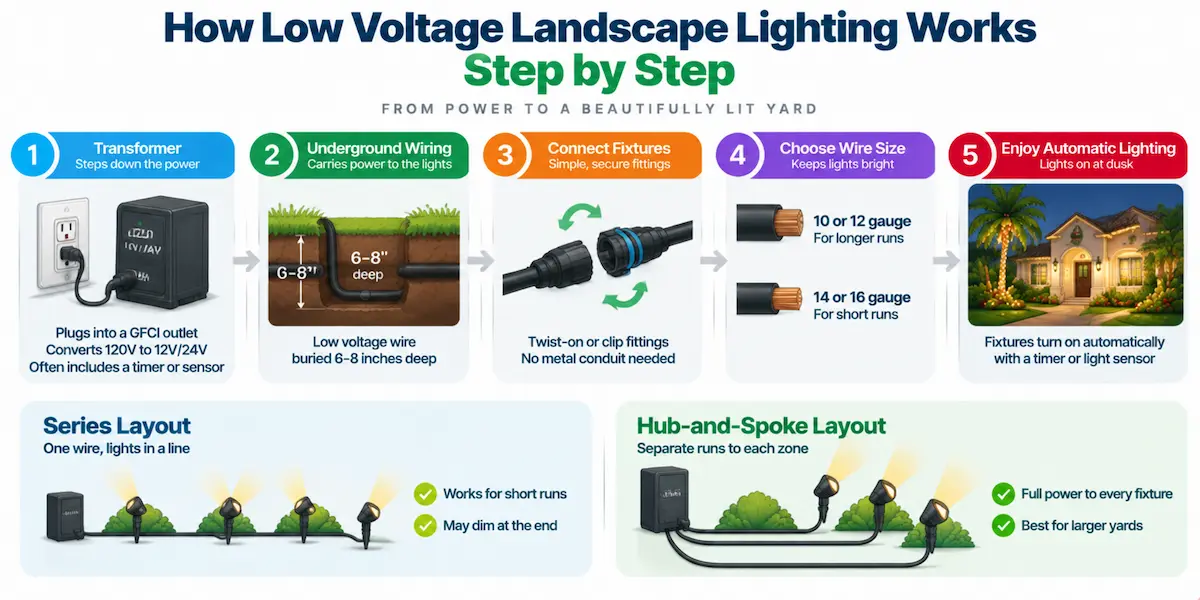
The transformer sits at the center of the whole setup. It plugs into a GFCI outdoor outlet. It pulls in your home’s 120-volt power and sends out a steady 12 or 24 volts. Most units also hold a timer or a light sensor. Your fixtures turn on at dusk without you flipping a switch.
From there, low voltage wiring runs underground to each light. Crews bury this wire 6 to 8 inches deep. Fixtures connect with twist-on or clip fittings, no metal conduit needed. Wire size matters too. Thicker 10 or 12 gauge wire carries power further without losing strength. Thin wire works fine for short runs close to the transformer.
Fixtures link up two main ways. A series layout strings lights along one wire. This works well for a short path but can dim the last few fixtures on a long run. A hub-and-spoke layout sends separate wire runs out from the transformer to each zone. Every fixture gets full power this way. Bigger Naples yards usually need the hub-and-spoke setup to avoid voltage drop, the term for lights losing brightness the farther they sit from the transformer. The fix for voltage drop is heavier wire or a second wire run, not one long line.
How Does Low Voltage Landscape Lighting Work Compared to Line Voltage?
Low voltage beats line voltage on safety, cost, and how easy it is to install yourself. This table lays out the main differences side by side.
| Feature | Low Voltage (12V/24V) | Line Voltage (120V) |
|---|---|---|
| Installer needed | DIY-friendly | Licensed electrician |
| Shock risk | Very low | Serious |
| Permit needed | Rarely | Usually yes |
| Wire burial depth | 6 to 8 inches | 18 inches |
| Fixture cost | $15 to $150 | $40 to $300 |
| Easy to expand | Yes | Harder |
Low voltage wins on safety and flexibility for almost every home yard. Line voltage still shows up on a few commercial jobs that need more output. Most Naples homes never need it. Ask about your fixture count and layout before you assume which system fits your budget.
Common Low Voltage Fixtures for Naples Yards
Five fixture types cover almost every low voltage lighting need in a Naples yard.
- Path lights line walkways and driveways so you can see where you step.
- Spotlights point up at palm trees, columns, or a front door to create a focal point.
- Well lights sit flush with the ground. They stay out of sight during the day.
- Flood lights cover wide, open spots like a side yard or a big lawn.
- Deck and step lights mark stair edges and cut down on trip hazards.
- Underwater lights add a soft glow to pools, ponds, and fountains after sunset.
Most Naples yards mix three or four of these fixture types instead of leaning on just one. A front yard often pairs path lights with a couple of spotlights on a favorite palm, while a backyard leans on deck lights and pool lighting for evening use. Fixture spacing matters as much as fixture choice. Check our path lighting spacing guide before you buy. Crowded path lights waste money, and spread-out lights leave dark gaps between them.
Is Low Voltage Lighting Safe for Naples’ Salt Air and Storms?
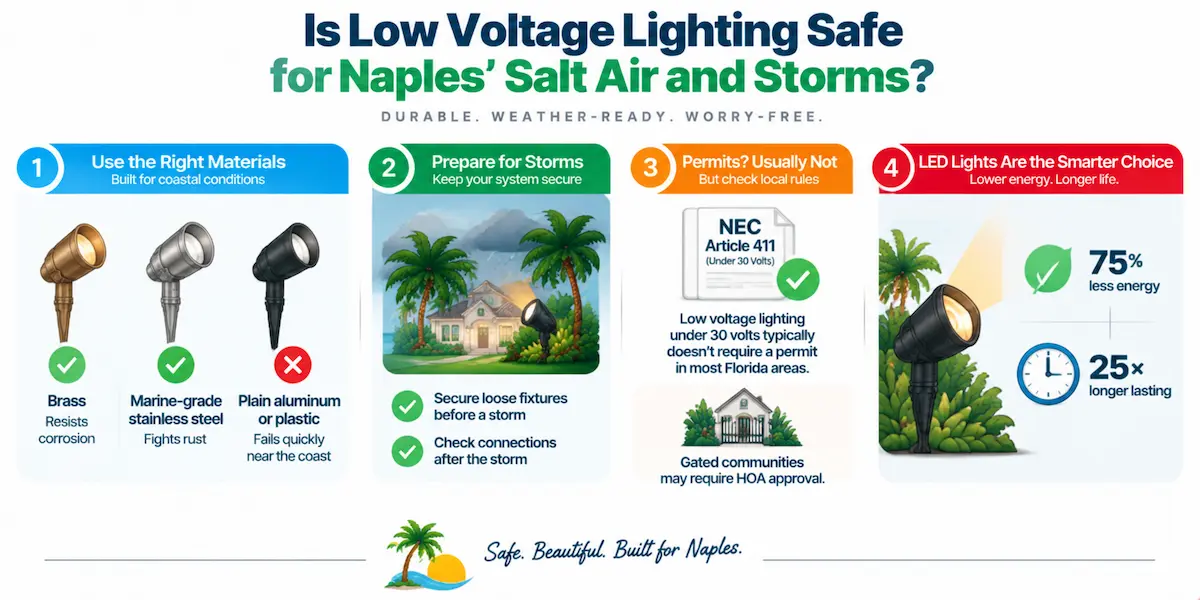
Salt air eats through cheap metal fast. Pick fixtures made from brass or marine-grade stainless steel, not plain aluminum or plastic. These materials fight off pitting and rust near the coast. A fixture built for a dry inland climate often fails within a year or two out here.
Hurricane season adds one more thing to plan for. Secure loose fixtures before a storm hits. Check wiring connections after a storm passes for water damage or debris.
Permits rarely come up for these systems. Low voltage lighting under 30 volts falls under NEC Article 411. Most Florida cities and counties skip the permit and electrician rule at that voltage. Gated Naples communities often still want design approval from the HOA board, so check with them on a separate track from any code question.
The energy math favors LED fixtures too. LED landscape lights use at least 75% less energy and last up to 25 times longer than incandescent bulbs, according to the U.S. Department of Energy. That gap adds up fast in Naples, where landscape lighting often runs most of the night through long summer evenings.
DIY or Call Light Up Naples Holiday & Outdoor Lighting?
A small path lighting job with a handful of fixtures suits most DIY homeowners just fine. Bigger properties, multi-zone designs, or yards prone to voltage drop do better with a pro on the job.
Light Up Naples Holiday & Outdoor Lighting handles landscape lighting installs and repairs across Naples, FL. Our crew sizes transformers correctly and picks corrosion-resistant fixtures built for our coastal air. We also put up holiday lighting each winter, so one call covers your yard all year. A free design visit from our team maps out fixture count, transformer size, and wire runs before you spend a dollar on gear. Dial (239) 228-8700 to book yours.
Frequently Asked Questions
These are the questions Naples homeowners ask us most about low voltage landscape lighting.
How does low voltage landscape lighting work in humid Naples weather?
The transformer and wiring hold up fine in Naples humidity as long as fixtures carry a weatherproof rating and every connection stays sealed. Corrosion, not the humidity itself, causes most failures near the coast over time.
Do I need a permit for low voltage landscape lighting in Naples, FL?
Most homeowners here skip the permit for a 12V or 24V setup. NEC Article 411 exempts low voltage lighting from the rules that cover standard household wiring. Gated communities can still want HOA sign-off.
What size transformer do I need?
Add up the wattage of every fixture you plan to install. Multiply that total by 1.25 for headroom. Round up to the nearest standard transformer size. A 200-watt unit covers most mid-sized yards with 15 to 20 fixtures.
Why are my landscape lights dimmer at the end of the run?
That’s voltage drop. Fixtures farthest from the transformer get less power over a long wire run, especially with thin wire or a series layout instead of hub-and-spoke wiring.
How long do low voltage LED fixtures last?
Quality LED fixtures run for 30,000 to 50,000 hours. That works out to 15 to 20 years of use at typical nightly hours.
The Bottom Line
Now you know how low voltage landscape lighting works. A transformer steps down your home’s power. Buried wire carries it out to each fixture. The whole setup stays safe enough to touch, dig near, or adjust on your own.
Naples’ salt air and storms make fixture material and install quality matter more here than in most places. Skimping on fixture grade now usually means replacing lights within a couple of seasons. Light Up Naples Holiday & Outdoor Lighting designs and installs these systems for homes across Naples, FL. Call (239) 228-8700 for a free consultation. Most projects start with a walkthrough, not a purchase.